In this article you will read,
- why companies are increasingly looking for European cloud alternatives to US hyperscalers and what role digital sovereignty plays in this,
- what advantages, but also what limitations, European cloud offerings have compared to US hyperscalers, and
- which clouds the independent iX report examines and how the T Cloud Public compares.
Cloud computing is one of the most important foundations of digital transformation today. Applications are delivered faster, new business models can be implemented more flexibly, and IT resources can be scaled as needed. At the same time, the requirements for cloud infrastructures have changed significantly in recent years. In addition to performance, availability and cost-effectiveness, topics such as digital sovereignty, data protection, compliance and resilience are becoming increasingly important.
Many companies are therefore questioning their previous cloud strategy. They are not necessarily looking for a complete replacement for the large US hyperscalers, but for a balanced architecture that combines innovation with control. European alternatives to hyperscalers are coming more into focus – especially when sensitive data is processed, regulatory requirements have to be met or companies want to reduce their technological dependency.
The market has developed accordingly. In addition to the international offerings of AWS, Microsoft Azure and Google Cloud, powerful European cloud alternatives are now available that combine modern public cloud services, open technologies and high security standards. At the same time, the question arises for many companies: What actually distinguishes a European cloud – and in which scenarios is it a real alternative?
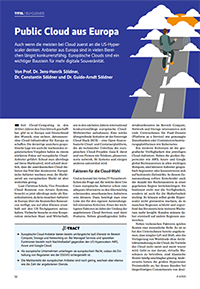
Among other things, the iX report Public Cloud from Europe, published in 2025, provides orientation. The independent study by Söldner Consult compares eight European alternatives to US hyperscalers based on practice-relevant criteria – from technical infrastructure and management functions to security features and automation. The report provides companies with valuable clues, but does not replace the individual assessment of their own requirements. This is exactly what this article is intended to support.