Help & ContactMarketplaceCommunityDEENDEENDiscoverSolutionsIndustriesPublic sectorHealthcareFinance & insuranceEnergy & utilitiesIndustry & manufacturingRetail & logisticsUse CasesArtificial intelligenceHigh Performance ComputingBig data and analyticsInternet of ThingsDisaster RecoveryData StorageTurnkey solutionsTelekom cloud solutionsPartner cloud solutionsT Cloud SwitzerlandReferencesProductsCloud ServicesRoadmapRelease NotesService descriptionCertifications and attestationsCloud as a ServiceConsulting & MigrationManaged ServicesBenefitsSecurity/GDPRSovereigntySustainabilityOpenStackMarket leaderBusiness NavigatorPricesPricing modelsComputing & ContainersStorageNetworkDatabase & AnalysisSecurityManagement & ApplicationsPrice calculatorResourcesPartnerCIRCLE PartnerTECH PartnerBecome a partnerAcademyTraining & certificationsCommunityStudies and whitepaperWebinarsBusiness NavigatorMarketplaceDiscover appsBecome a sellerNewsBlogFairs & eventsSuccess StoriesSupportSupport from expertsAI chatbotShared ResponsibilityGuidelines for Security Testing (Penetration Tests)Mobile AppHelp toolsFirst stepsTutorialStatus DashboardSwitch of cloud providerFAQTechnical documentationHelp & ContactMarketplaceCommunity

 Fast & Reliable:

Contact our support

Book now and claim 250 € starting credit
DiscoverSolutionsIndustriesUse CasesTurnkey solutionsT Cloud SwitzerlandReferencesProductsCloud ServicesCloud as a ServiceBenefitsBusiness NavigatorPricesPricing modelsPrice calculatorResourcesPartnerAcademyMarketplaceNewsSupportSupport from expertsHelp toolsTechnical documentation
  • Fast & Reliable:
  • Contact our support
Book now and claim 250 € starting credit

Ubiquitous Cloud-Native Service (UCS)

As containerized cloud-native applications become deeply integrated into various business scenarios within enterprises, new demands are increasingly prominent. These demands include cross-cloud and cross-region unified collaborative governance, as well as ensuring consistent application experiences. To meet these demands, Ubiquitous Cloud-Native Service (UCS) has emerged, thereby accelerating the cloud-native upgrade across various industries.

UCS is a platform for the centralized management of distributed clusters and enables unified collaborative governance of containerized cloud-native applications across clouds and regions. It runs on Karmada, the CNCF’s first multi-cloud container orchestration project, and supports unified management of T Cloud Public's cloud infrastructure (CCE clusters, CCE Turbo clusters), on-premises infrastructure (self-managed Kubernetes clusters), and third-party cloud infrastructure (other cloud vendors' Kubernetes clusters).  

UCS provides enterprises with a consistent experience across all domains, encompassing the deployment and management of cloud-native services as well as the application ecosystem. This comprehensive coverage spans a wide range of use cases, including core zones, hotspots, customer data centers and business sites. This ensures that customers are not constrained by geographical location, cross-cloud limitations or traffic restrictions when using cloud-native applications. By bringing cloud-native capabilities to every business scenario within an enterprise, UCS accelerates the adoption of cloud-native technologies across various industries.

Abstrakte Darstellung eines cloud-nativen Netzwerks mit zentralem Cloud-Symbol und dynamischen Datenverbindungen in einer modernen Multi-Cloud-Umgebung

Reasons for UCS in the T Cloud Public

Ein Schloss und im Hintergrund ein Server

Unified access and management for cross-cloud and cross-region clusters

UCS supports unified access and management for clusters across clouds and regions. It can connect to T Cloud clusters and attached clusters.

Stilisiertes Icon einer Tacho-Anzeige

Unified scheduling of computing power, optimal deployment & performance.

Based on the Karmada kernel, UCS can achieve unified access for thousands of distributed clusters, enabling collaborative scheduling of millions of node resources. With response times measured in seconds, UCS can optimize application deployment based on global resource distribution and business characteristics, considering factors such as geographical location, Quality of Service (QoS) and resource balancing.

Grüner Pfeil mit Connect-Symbol im Hintergrund

Simple, easy-to-use & secure Image Repository functions

UCS deeply integrates the capabilities of T Cloud Public's Image Repository for Container (SWR). It supports full lifecycle management of images, providing users with simple, easy-to-use, secure, and reliable image management functions to help them quickly deploy containerized services.

Drei Accounts und im Hintergrund ein Schlüssel

Permission Management

UCS Permission Management is built on the capabilities of T Cloud Public's Identity & Access Management Service (IAM) and Kubernetes' Role-Based Access Control (RBAC). It not only supports the fine-grained permission control based on IAM and IAM Token authentication, but also supports permission control at the cluster level, container fleet level, cluster namespace level, and container fleet namespace level.


Key Features of UCS

Visualisierung einer vernetzten Multi-Cloud-Infrastruktur mit verbundenen Cloud-Symbolen und digitalen Netzwerkverbindungen auf einer technologischen Plattform

One-Stop Multi-Cloud Unified Experience

UCS supports unified access and management of Kubernetes clusters across regions and clouds (T Cloud Public, On-Premises, and third-party clouds) scenarios. Additionally, it provides permission management for enterprise-level project tenants, enabling fine-grained management of sub-account access permissions to Kubernetes resources. This facilitates compliance audits for multi-cloud and multi-cluster environments.

 
Icon einer Geschwindigkeitsanzeige

Collaborative Computing Power

UCS is developed based on the multi-cluster management project Karmada. Through the capabilities of a multi-cloud management platform, it can support the unified access of thousands of distributed Kubernetes clusters.  

Furthermore, it can support the collaborative scheduling of millions of node resources, enabling elastic scaling of applications across clouds and clusters in distributed cloud scenarios. It also facilitates cross-cloud migration of applications in the event of a failure. Based on the global distribution of resources and the characteristics of the business, it can optimize the deployment of applications according to conditions such as geographical location, network QoS, and resource balance. This allows users to provide the computing power resources required by applications at any time and place.

Icon einer Skala mit mehreren Punkten

Traffic Distribution & Scheduling

With the unified traffic entry point MCI (Multi Cluster Ingress), the boundaries between regions and clusters have been broken down, an intelligent scheduling hub spanning clouds and regions has been established for enterprises. 

It not only significantly reduces the complexity of managing multiple clusters but also achieves high availability and elastic scalability of services through refined traffic routing policies and automated health checks. Combined with full-stack TLS security protection, it ensures flexible and efficient traffic distribution while providing continuous assurance for globally distributed applications.


Use Cases

E-commerce Live Streaming

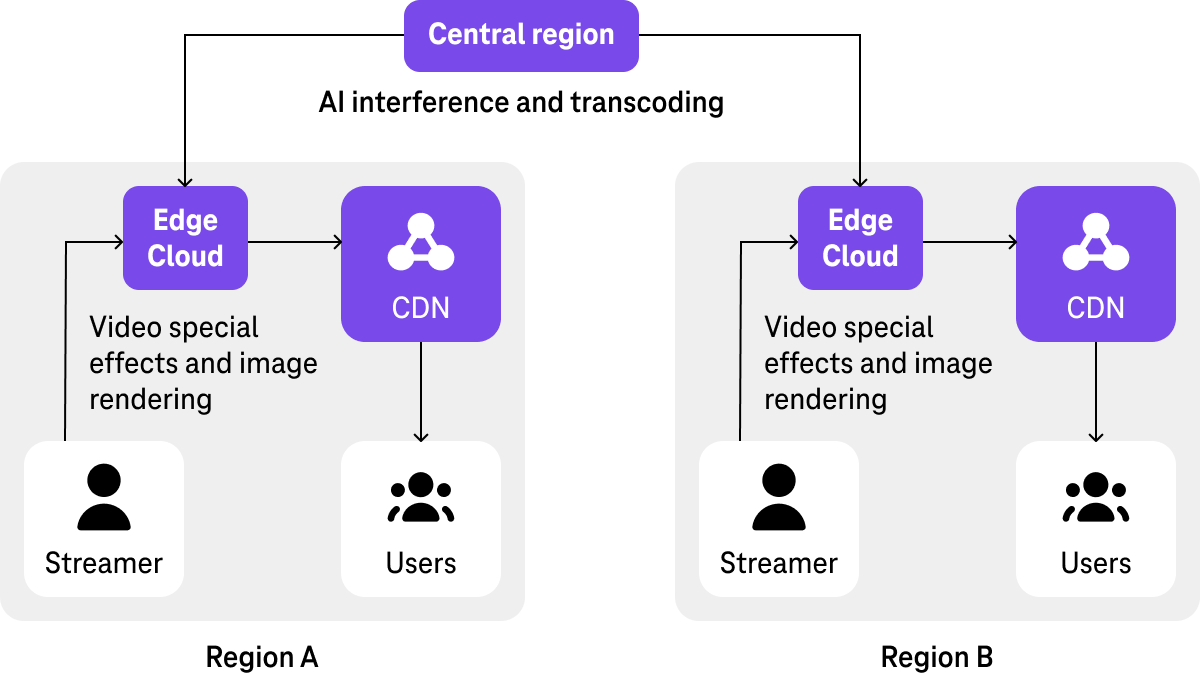
During specific live streaming time slots, or during promotional events, flash sales, and other activities, e-commerce live streaming customers may encounter a sudden surge in user traffic. This can lead to a shortage of server resources and an increase in service latency.

To address the traffic impact during business peak periods, UCS provides distributed traffic management and computing power scheduling management capabilities. These capabilities allow for flexible allocation of business traffic and edge-cloud resources, effectively enhancing business stability and user experience.

Infographic of a distributed cloud-native architecture with a central region for AI inference and transcoding, connected to multiple edge clouds for video special effects, image rendering, and content delivery across different regions
Automotive Industry

With the emergence of new business scenarios such as the Internet of Vehicles (IoV), the automotive industry is witnessing a continuous rise in new scenarios such as digital marketing, smart production, and smart stores. The digital transformation of the traditional automotive industry has become a trend in industrial development. However, at the same time, it also faces various challenges.

Challenge 1: Traditional steady-state business resource utilization is not high, and basic resources cannot be effectively integrated.

Challenge 2: Insufficient elasticity, unable to meet the concurrent access demands of a large number of online users, resulting in high network latency.

Challenge 3: Involves a wide variety of business types, with cluster deployments being scattered, making operation and maintenance management difficult.

The UCS platform organically integrates resources from different cloud providers, achieving unified management of computing power, traffic, and data. This accelerates the digital transformation of the automotive industry.

Unified Supply of Computing Power: Establish a shared platform for both agile and stable business operations. Integrate all cloud resources to effectively improve the sharing rate and resource utilization.

Unified Traffic Management: Adapt to innovative business scenarios such as the Internet of Vehicles (IoV) and the Internet. Achieve flexible access based on business characteristics, thereby reducing user latency.

Unified Management Platform: Provide a unified entry point for the operation and maintenance of distributed applications across the entire network, thereby improving operational and maintenance efficiency.


Book now and claim 250 € starting credit*

Book now
 

*Voucher can be redeemed until 31 December 2026 and expires two months after conclusion of the contract. The credit is deducted according to the valid list prices as per the service description. Payment of the credit in cash is excluded.

 
Take advantage of our consulting services!
Our experts will be happy to help you.
We will answer any questions you have regarding testing, booking and usage – free and tailored to your needs. Try it out today!

Hotline: 24 hours a day, seven days a week 
0800 3304477from Germany
+800 33044770from abroad
Write an E-mail

*Voucher can be redeemed until 31 December 2026 and expires two months after conclusion of the contract. The credit is deducted according to the valid list prices as per the service description. Payment of the credit in cash is excluded.


T Cloud Public Community

This is where users, developers and product owners meet to help each other, share knowledge and discuss.

Discover now

Free expert hotline

Our certified cloud experts provide you with personal service free of charge.

0800 3304477 (from Germany)

+800 33044770 (from abroad)

24 hours a day, seven days a week

Write an E-Mail

Our customer service is available free of charge via E-Mail

Write an E-Mail

AIssistant Cloudia

Our AI-powered search helps with your cloud needs.