MarketplaceCommunityDEENDEENDiscoverProductsCloud ServicesRoadmapRelease NotesService descriptionCertifications and attestationsManaged ServicesBenefitsSecurity/DSGVOSovereigntySustainabilityOpenStackMarket leaderBusiness NavigatorSovereigntyPricesPricing modelsComputing & ContainersStorageNetworkDatabase & AnalysisSecurityManagement & ApplicationsPrice calculatorSolutionsIndustriesHealthcarePublic SectorScience and researchAutomotiveMedia and broadcastingRetailUse CasesArtificial intelligenceHigh Performance ComputingBig data and analyticsInternet of ThingsDisaster RecoveryData StorageTurnkey solutionsTelekom cloud solutionsPartner cloud solutionsSwiss T Cloud PublicReferencesPartnerCIRCLE PartnerTECH PartnerBecome a partnerAcademyTraining & certificationsEssentials trainingFundamentals training coursePractitioner online self-trainingArchitect training courseCertificationsCommunityCommunity blogsCommunity eventsLibraryStudies and whitepaperWebinarsBusiness NavigatorMarketplaceSupportSupport from expertsAI chatbotShared ResponsibilityGuidelines for Security Testing (Penetration Tests)Mobile AppHelp toolsFirst stepsTutorialStatus DashboardSwitch of cloud providerFAQTechnical documentationNewsBlogFairs & eventsTrade pressPodcastMarketplaceCommunity

0800 3304477 24 hours a day, seven days a week

Get in touch 

Book now and claim 250 € starting credit
DiscoverProductsCloud ServicesManaged ServicesBenefitsBusiness NavigatorSovereigntyPricesPricing modelsPrice calculatorSolutionsIndustriesUse CasesTurnkey solutionsSwiss T Cloud PublicReferencesPartnerCIRCLE PartnerTECH PartnerBecome a partnerAcademyTraining & certificationsCommunityLibraryBusiness NavigatorMarketplaceSupportSupport from expertsHelp toolsTechnical documentationNewsBlogFairs & eventsTrade pressPodcast
  • 0800 330447724 hours a day, seven days a week
  • Get in touch 
Book now and claim 250 € starting credit

Cloud in public administration: Successfully implementing electronic records

by Editorial Team
An employee is working at a computer workstation in a modern office setting, while another person is standing in the background in an administrative area.
Digitizing public administration – with e-records from the sovereign cloud
 

In this article, you will read

  • why electronic records management plays a strategic role in the digital transformation of public administration,
  • how a sovereign cloud benefits public administration
  • and how the cloud compares with other delivery models.


Electronic records management is considered a core component of administrative digitalization in Germany. Nevertheless, many public authorities continue to operate in hybrid environments in which digital processes intersect with paper-based workflows. The result is fragmented processes, inefficient workflows, and a level of digitalization that often provides only limited practical value in day-to-day operations. At the same time, the political framework has long been in place. Initiatives such as the Online Access Act (OZG), the E-Government Act, and the German Administrative Cloud Strategy are driving the modernization of public administration. In practice, however, implementation continues to fall short of expectations. Compared with other European countries, Germany still ranks in the middle tier for e-government performance. Against this backdrop, the use of a sovereign cloud in public administration is becoming increasingly important as a scalable and future-oriented operating model.
Why is electronic records management strategically relevant?

Electronic records management is far more than a digital repository for documents. One key advantage is standardized, transparent, and traceable records management. When cloud solutions are used consistently in public administration, information is no longer managed in decentralized systems or paper-based files. Instead, it is organized in a structured, audit-proof, and digitally accessible manner. This enables transparent administrative processes that are easier for both employees and citizens to understand and follow.

Based on our project experience, we see electronic records management as the preferred starting point for the digital transformation of public administration. It creates the foundation for more advanced process digitalization and for the use of modern technologies such as AI."

Philipp Perplies, COO Public Sector at d.velop

Electronic records management also enables significantly better collaboration across departments and organizational units. Information can be accessed regardless of time or location, which is a major efficiency advantage, particularly in distributed administrative structures. Information retrieval also improves substantially. Instead of relying on physical files or fragmented file systems, public authorities gain access to a centralized and structured information base that accelerates processes and reduces media discontinuities. Finally, electronic records management serves as an enabler for the next stages of digital transformation, including workflow automation and the use of AI. This is where the sovereign cloud demonstrates its full potential: as a scalable platform for intelligent administrative processes.


Need to catch up with public sector digitalization

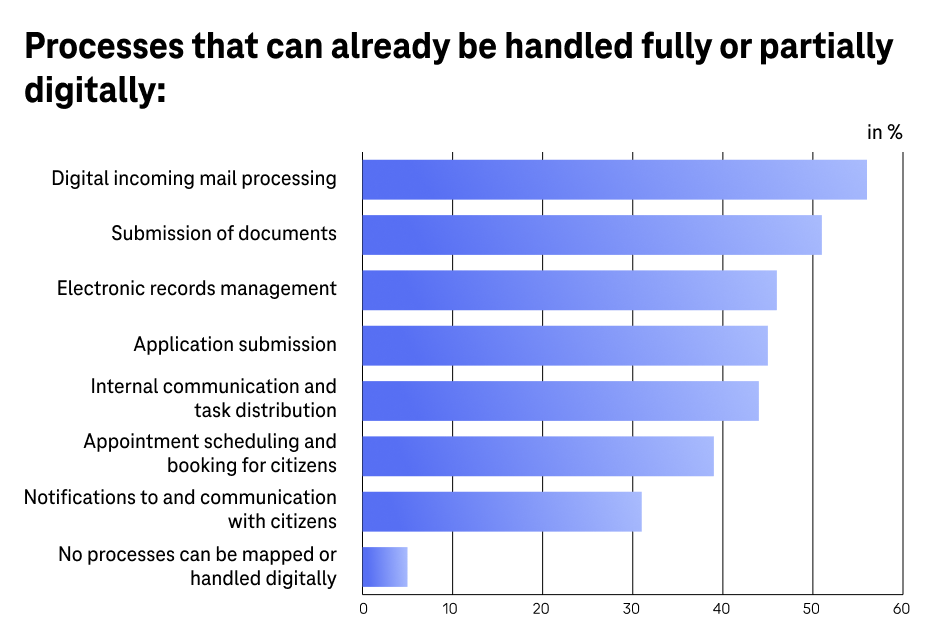
Studies continue to paint a picture of slow progress in public sector digitalization. According to the d.velop study Digitalization in the Public Sector 2025, digital mail intake via email remains the most widely used “digital” tool. Although electronic records management is gaining momentum, it is still far from being implemented on a broad scale.

Horizontal bar chart with multiple blue bars on a dark background for visualizing comparative or survey data

Source: Digitalization in the Public Sector 2025, d.velop

A spot check by the German Press Agency also illustrates the gap clearly: ten years after the adoption of the Berlin E-Government Act, only between five and 20 percent of employees in Berlin’s district administrations are working with 
electronic records management systems. The use of a sovereign cloud in public administration could provide a significant boost to implementation efforts, meaning the potential for further development remains substantial.


What requirements apply to electronic records management in public administration?

Introducing electronic records management in public administration is closely tied to regulatory, organizational, and technical requirements. These differ significantly from those associated with traditional IT projects in the private sector.

One key aspect is compliance with legal and data protection requirements. This includes obligations under data protection law as well as public-sector-specific regulatory frameworks. The handling of personal data requires clear rules governing storage, access, and processing. Closely linked to this is the issue of information security and digital sovereignty. Public authorities must ensure that data is processed within clearly defined legal frameworks. Any organization using a sovereign cloud in public administration must therefore select its provider and operating architecture carefully to prevent third-country access and uncontrolled data transfers.

Another important factor is integration with existing specialized administrative applications and IT environments. Electronic records management should not be treated as an isolated solution. Instead, it must be embedded within existing administrative processes. Only then can end-to-end digital workflows be established without media discontinuities. There are also requirements related to long-term availability and archiving. Administrative records must remain traceable, unaltered, and accessible over extended periods. This places particular demands on data management and system architecture.

Finally, organizational feasibility also plays a decisive role. Introducing electronic records management fundamentally changes how public administration operates, especially when a sovereign cloud is selected as the operating model. Successful projects demonstrate that technical implementation alone is not sufficient. In particular, process adaptation and employee involvement are critical factors in determining long-term success.


Where are electronic records stored?

In principle, electronic records in public administration can be stored using a range of operating models. In recent years, cloud-based solutions in public administration have become increasingly important. Choosing a storage model is not merely a technical decision, but also a strategic one, as it affects security, operations, scalability, and governance. In general, three common models can be distinguished.

Municipal or city data centers

Many municipalities and public sector organizations operate their IT infrastructure through their own data centers or through municipal data centers. In this model, electronic records management is hosted within a locally or regionally controlled environment.

Key characteristics of this model include:

  • A high level of control over infrastructure and data storage.
  • Close alignment with departments and strong organizational integration.
  • Established structures within many existing IT environments.

At the same time, this model is often associated with considerable internal operational effort. Maintenance, scaling, and modernization must be managed by the public sector organization itself, which can be particularly challenging when IT resources are limited.

Government IT service providers and public sector data centers

Another common option is operation through centralized public sector IT service providers at the state or federal level. In this model, infrastructure and services are consolidated to leverage synergies and standardize platforms.

Typical features include:

  • Centralized operations for multiple public authorities or municipalities.
  • Standardized platforms and security frameworks.
  • Reduced infrastructure responsibilities for individual administrations.

This model offers significant economies of scale. In practice, however, it can also involve longer decision-making and adaptation cycles.

Sovereign or highly regulated cloud infrastructures in the EU or Germany

An increasingly important model is the operation of electronic records management within a sovereign cloud environment designed specifically to meet the requirements of public administration. This approach combines the benefits of cloud computing, such as scalability, flexible resource usage, and modern operating models, with strict requirements for data protection, security, and regulatory compliance.

Key characteristics include:

  • Operation within European or national legal jurisdictions.
  • Clear rules governing data access, data protection, and governance.
  • Scalability without the need for in-house infrastructure investments.
  • A focus on certified security and compliance standards.

Against the backdrop of current debates, sovereign and certified cloud infrastructures are becoming increasingly important in public administration. At the same time, they address common challenges associated with traditional on-premises environments, such as high operational overhead and limited scalability.


What are the strengths and weaknesses of the individual storage models?

Choosing the right operating model for electronic records management in public administration always involves balancing priorities. None of the available options is inherently superior. What matters is how well a model aligns with the organizational, technical, and regulatory framework of a particular public administration body. The following section compares the three common models based on key criteria.

Comparison of storage and operating models

Criterion

Municipal data center

Government IT service provider

Sovereign cloud (EU/DE)

Control over data

Very high

High

Medium to high, depending on contractual safeguards

Internal operational effort

High

Medium

Low

Scalability

Limited

Medium

Very High

Time required to introduce new functions

Slow to moderate

Moderate

Fast

Standardization

Low to medium

High

High, platform-based

Flexibility for specialized administrative applications

High, individualized

Medium

High, through interfaces

Regulatory compliance

High, if operated correctly

Very high

Very high, with certified providers

Dependence on internal IT resources

Very high

Medium

Low


Municipal data centers: Maximum control, high operational overhead

This model offers the highest level of direct control over infrastructure and data management. For public authorities with a well-developed internal IT organization, this can be a significant advantage. At the same time, however, operating this model is resource-intensive. Updates, scaling, and ongoing development must be managed internally or through external service providers. As demand for digital public services continues to grow, this can become a major bottleneck.

Government IT service providers: Standardized and established

Centralized public sector IT service providers offer a strong balance between control and operational relief. Standardized platforms create economies of scale while also supporting consistent security and operating models. However, the rollout of new features or custom adaptations can be slower in centralized structures than in more flexible operating models.

Sovereign cloud: High scalability with clear governance

A sovereign cloud in public administration offers particular advantages in terms of scalability, speed, and reduced pressure on internal IT teams. The key prerequisite, however, is a clearly defined regulatory framework. Only when data protection, data residency, access controls, and responsibilities are clearly governed can the cloud fully realize its potential in the public sector. For public authorities with limited IT resources or increasing pressure to digitalize, this model can serve as a major accelerator.

Which operating model is the right fit?

The differences among these models make one thing clear: there is no universally “best” operating model for electronic records management. Instead, selecting the right model is a strategic decision that depends heavily on factors such as:

  • The maturity level of the organization’s digital administration.
  • The availability of internal IT resources.
  • Requirements related to sovereignty and regulatory compliance.
  • The expected pace of digital transformation.

As a result, electronic records management operated through a sovereign cloud in public administration is becoming a central driver of administrative digitalization, not only from a technical perspective, but above all from an organizational one.


Benefits of the cloud in public administration: What makes electronic records management compelling?

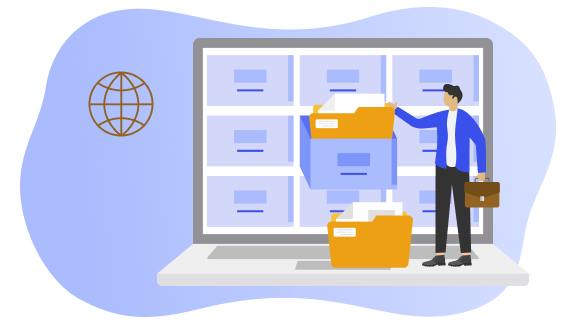
Illustration of a person managing digital documents and file folders on a laptop, symbolizing electronic records management and digital management systems

A sovereign cloud in public administration can deliver significant benefits for public sector organizations, particularly when used to operate electronic records management systems. The prerequisite is a clearly defined technical, organizational, and regulatory framework. In this context, the cloud is not an end in itself, but rather an operating model designed to improve scalability, efficiency, and the use of internal resources. Within the broader context of administrative digitalization, this model becomes especially relevant when existing IT structures reach their limits or when demand for digital public services increases rapidly.

Scalability and future readiness

One of the primary advantages of the cloud is its flexible scalability. Capacity can be adjusted to accommodate rising user numbers, growing data volumes, or new requirements without the need to build additional physical infrastructure. In public administration, where digitalization projects are often implemented in stages, this creates far greater flexibility to respond to future demands.

Reduced burden on internal IT teams

When a sovereign cloud in public administration is used to operate electronic records management, key tasks such as maintenance, updates, and infrastructure management are transferred to the provider. For many public authorities, this is a major advantage because IT resources are often limited while multiple digitalization initiatives must be managed simultaneously. This allows internal IT teams to focus more on strategic priorities and the further development of specialized administrative applications rather than on day-to-day system operations.

Faster implementation and continuous enhancement

Cloud-based solutions in public administration enable faster deployment of new features and continuous enhancement of electronic records management platforms. Unlike traditional on-premises structures, they eliminate the need for extensive local infrastructure expansion. As a result, digital administrative processes can be modernized more quickly, and new requirements can be implemented with greater flexibility.

Improved access and collaboration

Another advantage is location-independent and time-independent access to files and documents for authorized employees. This greatly simplifies collaboration, particularly across departments, locations, and external entities within public administration. It also significantly reduces media discontinuities and the circulation of physical files.

Integration with specialized administrative applications and digital workflows

Modern cloud solutions for electronic records management can generally be connected to existing specialized administrative applications, document management systems, and workflow components through standardized interfaces. This creates an end-to-end digital process environment in which records are not managed in isolation, but are actively integrated into administrative workflows.

Cost efficiency and cost structure

Another benefit lies in the shift in cost structure. Instead of requiring substantial upfront investments in in-house infrastructure, cloud models create usage-based operating costs that are easier to predict and manage. This can be particularly relevant for smaller municipalities or public administrations with limited budgets because it lowers investment barriers.

Assessment: Benefits depend on clear framework conditions

The benefits outlined above can only be fully realized if key prerequisites are in place. These include:

  • Clear rules for data protection and data management.
  • A controlled operating and access model.
  • The selection of a suitable and regulated cloud provider.
  • Integration into existing administrative and domain-specific processes.

Without these framework conditions, the advantages can quickly give way to new dependencies or increased complexity.


Cloud in public administration: When is it the right choice for electronic records management?

Introducing a cloud-based electronic records management system in public administration is not purely a technical decision. It affects the organization, processes, IT strategy, and regulatory requirements alike. As a result, there is no one-size-fits-all answer. There are, however, clear criteria for determining when cloud-based electronic records management makes sense and when it may not. 

The following guiding questions can help frame that decision:

Organizational requirements 
How far has the administration been digitized?

A cloud-based electronic records management system delivers the greatest value when processes are already designed with digital workflows in mind.

Cloud solutions are particularly suitable when:

  • Digital workflows, such as mail intake or approval processes, are already established or are being actively planned.
  • Time-of-business applications need to be integrated.
  • Multiple organizational units require shared access to records.

Greater caution is needed when:

  • Paper-based workflows still dominate.
  • Electronic records management is viewed primarily as a “digital archive.”

In these cases, even a cloud solution will not resolve the underlying structural issues.

IT resources
Relief or dependency?

One of the main arguments in favor of cloud-based electronic records management is the reduced burden on internal IT teams. At the same time, however, responsibility shifts to the provider.

Cloud solutions offer clear benefits when:

  • IT resources are limited.
  • Operations, maintenance, and updates cannot or should not be handled internally.
  • Future scaling is expected, for example due to growing user numbers or increasing data volumes.

A more careful assessment is required when:

  • There are strong requirements for highly customized adaptations.
  • Deep integration with existing systems is necessary.

The central question is therefore not simply “cloud or not,” but rather how much control should remain in-house and how much should be intentionally outsourced.

Regulation and sovereignty
Does the operating model meet the requirements?

Whenever cloud solutions are used in public administration for electronic records management, data protection, information security, and digital sovereignty play a central role.

A cloud-based electronic records management system is well suited when:

  • The provider can clearly demonstrate compliance with European or national data protection requirements.
  • Data storage, access controls, and the operating model are governed transparently.
  • No legal conflicts, such as risks related to third-country access, are expected.

Greater caution is advisable when:

  • Data flows or responsibilities are unclear.
  • Sensitive data is to be processed without appropriate safeguards.

The key consideration is not “cloud or on-premises,” but whether the chosen model can be operated in a legally compliant and audit-proof manner.

Cost efficiency
Investment versus operating costs

Introducing cloud-based electronic records management changes the overall cost structure.

Cloud solutions are economically attractive when:

  • High upfront investments in in-house infrastructure should be avoided.
  • Costs need to be predictable and usage-based.
  • Smaller or mid-sized municipalities are working with limited budgets.

On-premises solutions can offer advantages when:

  • Existing infrastructure is already in place and fully depreciated.
  • Long-term usage is expected to remain very stable without major scaling requirements.

A reliable cost-effectiveness assessment should always consider the full lifecycle of the solution, not just the initial implementation costs.

Overview
Typical decision scenarios

 Cloud-based electronic records management is particularly well suited for:

  • Municipalities with limited IT resources.
  • Organizations with a strong need for collaboration and cross-location access.
  • Public administrations seeking to accelerate digital transformation.


A traditional or hybrid solution may be more appropriate for:

  • Organizations with highly specialized administrative applications and exceptional requirements.
  • Environments with especially stringent protection requirements for specific categories of data.
  • Public administrations that already maintain a highly developed in-house IT infrastructure.

Interim conclusion
The cloud in public administration is not an end in itself, but it is often the decisive enabler

The cloud in public administration is not a cure-all. When implemented correctly, however, it can become a central enabler of administrative digitalization, especially when organizational, technical, and regulatory conditions are properly aligned. The real challenge therefore lies less in the technology itself and more in selecting the right operating model for electronic records management.


Electronic records management in practice

The introduction of a sovereign cloud in public administration, together with electronic records management, demonstrates clearly that digital transformation is not driven by technology alone. It depends on the interaction of processes, organizational change, and clearly defined goals.

A real-world example from local government illustrates how this transformation can be implemented step by step. Höhr-Grenzhausen, a collective municipality in the Westerwald district, introduced electronic records management as the foundation for an end-to-end digital administrative structure. The starting point was the recognition that external digitalization requirements, such as those established by the Online Access Act (OZG), can only be implemented effectively if internal processes are already digitalized. “With the Online Access Act (OZG), we are basically putting the cart before the horse,” says Sebastian Kilb, Deputy Office Manager at the town hall. “We are expected to offer administrative services digitally, but how is that supposed to work if we are not yet fully digital internally?”

Transforming administration through centralized records management

For Sebastian Kilb and Philipp Menges, Head of the IT Infrastructure & Digitalization Staff Unit in the municipal administration, one thing became clear: “We need a structured new filing system with standardized records management across the entire administration based on a file plan.” By introducing standardized records management, the municipality established the foundation for the successful implementation of the OZG. In the first phase, it introduced electronic records management. In the second phase, it integrated electronic signatures. Together, these two foundational processes enabled digital workflows within the administration. In the third phase, the municipality connected the specialized administrative applications already in use, making digital functionality available directly within administrative processes.

Digital administrative processes improve citizen service

Since then, paper-based workflows and traditional routing folders have become a thing of the past. Rather than changing everything at once, the municipality transitioned departments to electronic records management step by step with a clear strategic direction. Digital inboxes and workflow routing reduce the workload for employees and accelerate administrative processes, benefiting both citizens and businesses within the municipality. At the same time, these digitalization measures create greater transparency for administrative cases, demonstrating what citizen-centered service looks like in practice.


Cloud in public administration: Municipal best practices with T Cloud Public and d.velop

The cloud in public administration delivers the greatest value when sovereign software and sovereign infrastructure are combined. As a leading European cloud platform, T Cloud Public provides public authorities and municipalities with exactly this combination: d.velop electronic records management operated within a German cloud environment designed to meet the highest security standards. An increasing number of municipalities are recognizing the strategic value of this approach. Cities including Rotenburg (Wümme), Wuppertal, and Oberhausen will share their experiences at the d.velop SUMMIT, taking place from June 9 to June 11, 2026, in Düsseldorf.

A colorful, iridescent gradient featuring the event title

d.velop SUMMIT 2026

More connectivity. More exchange. More to experience. The d.velop community will gather in Düsseldorf again this year to experience innovation together. 

Register for the event now
 

Conclusion: The cloud in public administration as an enabler of electronic records management

Electronic records management is a core component of the digital transformation of public administration. The use of a sovereign cloud in public administration creates the foundation for structured, traceable, and media-disruption-free administrative processes, making it a key driver of greater efficiency and transparency.

Choosing the right operating model, whether a municipal data center, a centralized IT service provider, or a cloud-based environment, is not purely a technical decision. It is a strategic choice that shapes the future direction of the organization. In particular, cloud solutions offer significant advantages in terms of scalability, flexibility, and reduced pressure on internal IT teams. At the same time, they require clearly defined framework conditions for security, sovereignty, and governance.

The decisive question, therefore, is not “cloud or no cloud,” but whether the chosen model is the right fit for the operational realities of the respective public administration organization. When implemented effectively, the cloud in public administration becomes a central enabler of modern digital administrative work, with electronic records management at its core.


FAQ: Frequently asked questions about electronic records management and the cloud in public administration

Is electronic records management in the cloud automatically less secure than a solution in an in-house data center?

No. The security of electronic records management does not depend solely on the operating model, but rather on how security, access controls, and data protection measures are implemented. Cloud environments can provide a very high level of security when they are appropriately certified and supported by clear governance structures.

Does using the cloud mean that public administration gives up control over its records?

No. In a professionally managed cloud environment, control over data, access rights, and processes remains with the public authority. Although responsibility for technical operations is outsourced, professional and organizational control remains in place.

Is the cloud also suitable for smaller municipalities?

Yes. Smaller municipalities often benefit in particular from cloud solutions because they do not need to build and operate their own complex IT infrastructure. This enables resources to be used more efficiently and digitalization projects to be implemented more quickly.

When is a hybrid solution more appropriate than a pure cloud solution?

Hybrid models are appropriate when certain line-of-business applications or datasets must remain on-premises because of regulatory or organizational requirements, while other components can be operated flexibly in the cloud. They support a gradual and controlled transformation approach.

How much does cloud-based electronic records management change day-to-day administrative work?

In most cases, the impact is substantial. Workflows become more digital, information becomes centrally accessible, and coordination increasingly takes place through digital processes. At the same time, this requires adjustments to established working methods and administrative procedures.

How complex is the transition to cloud-based electronic records management?

The level of effort depends heavily on the organization’s starting point. Key factors include the digital maturity of existing processes, the quality of existing data, and the integration of current line-of-business applications. In most cases, the transition is a multi-stage transformation project.

Can a cloud solution be introduced step by step?

Yes. In practice, implementation is often iterative, for example by starting with individual departments or selected processes. This allows the transition to be managed in a controlled manner and supported more effectively at the organizational level.

How can organizations avoid becoming too dependent on a single provider in the long term?

The key is to rely on open standards, interoperable interfaces, and clear contractual arrangements. When selecting a solution, organizations should also ensure from the outset that data portability and exit scenarios are built into the overall concept.


This content might also interest you
 

Illustration of a person holding the European flag in front of a cloud with a question mark and an exclamation point against a blue background

T Cloud Public is the undisputed test winner

Discover in the new white paper which European provider sets the benchmark in the areas of sovereignty, IAM, and automation.

 
A public administration employee in citizen services speaks with visitors at the reception desk.

Digitalization in public administration

More responsibilities, fewer staff: digitalization enables efficiency—with a sovereign cloud as the foundation for AI and automation.

 
A hand is holding a digital cloud graphic featuring the ‘BSI IT-Grundschutz’ seal. Connected lines and data structures surrounding the cloud symbolize IT security and cloud infrastructure.

T Cloud Public listed for IT-Grundschutz

Companies, public authorities, and institutions can already implement sovereign cloud strategies with the T Cloud Public. On July 28, 2025, T-Systems submitted its application for IT Baseline Protection certification to the BSI. Under certificate number BSI-IGZ-0757, the T Cloud Public is now officially listed, further strengthening its leading role in the European cloud market.


T Cloud Public Community

This is where users, developers and product owners meet to help each other, share knowledge and discuss.

Discover now

Free expert hotline

Our certified cloud experts provide you with personal service free of charge.

 0800 3304477 (from Germany)

 +800 33044770 (from abroad)

 24 hours a day, seven days a week

Get in touch

Our customer service is available free of charge.

Contact us

AIssistant Cloudia

Our AI-powered search helps with your cloud needs.