MarketplaceCommunityDEENDEENDiscoverProductsCloud ServicesRoadmapRelease NotesService descriptionCertifications and attestationsManaged ServicesBenefitsSecurity/DSGVOSovereigntySustainabilityOpenStackMarket leaderBusiness NavigatorPricesPricing modelsComputing & ContainersStorageNetworkDatabase & AnalysisSecurityManagement & ApplicationsPrice calculatorSolutionsIndustriesHealthcarePublic SectorScience and researchAutomotiveMedia and broadcastingRetailUse CasesArtificial intelligenceHigh Performance ComputingBig data and analyticsInternet of ThingsDisaster RecoveryData StorageTurnkey solutionsTelekom cloud solutionsPartner cloud solutionsSwiss T Cloud PublicReferencesPartnerCIRCLE PartnerTECH PartnerBecome a partnerAcademyTraining & certificationsEssentials trainingFundamentals training coursePractitioner online self-trainingArchitect training courseCertificationsCommunityCommunity blogsCommunity eventsLibraryStudies and whitepaperWebinarsBusiness NavigatorMarketplaceSupportSupport from expertsAI chatbotShared ResponsibilityGuidelines for Security Testing (Penetration Tests)Mobile AppHelp toolsFirst stepsTutorialStatus DashboardSwitch of cloud providerFAQTechnical documentationNewsBlogFairs & eventsTrade pressPodcastMarketplaceCommunity

0800 3304477 24 hours a day, seven days a week

Contact our support

Book now and claim 250 € starting credit
DiscoverProductsCloud ServicesManaged ServicesBenefitsBusiness NavigatorPricesPricing modelsPrice calculatorSolutionsIndustriesUse CasesTurnkey solutionsSwiss T Cloud PublicReferencesPartnerCIRCLE PartnerTECH PartnerBecome a partnerAcademyTraining & certificationsCommunityLibraryBusiness NavigatorMarketplaceSupportSupport from expertsHelp toolsTechnical documentationNewsBlogFairs & eventsTrade pressPodcast
  • 0800 330447724 hours a day, seven days a week
  • Contact our support
Book now and claim 250 € starting credit

Sovereign AI Cloud for Europe

by Editorial Team
Close-up of hands on a laptop keyboard. Superimposed on top are graphic elements featuring the letters “AI,” circuit diagrams, and data streams, symbolizing modern cloud architecture and AI applications in the cloud.
Modern AI clouds efficiently connect applications, data, and workloads across multiple layers. 
 

In this article, you'll read 

  • why a single cloud platform is usually not sufficient for production AI, and which architecture is more effective,
  • how a general-purpose cloud and a GPU cloud work together in a real-world customer scenario to reduce costs
  • and the five requirements a sovereign AI cloud must meet.


The strategic objective for many companies is clear: Artificial intelligence (AI) should automate processes, accelerate innovation, and secure long-term competitiveness. That sounds straightforward, but as always, the real challenge begins with implementation.
 

AI cloud instead of isolated solutions: Why modern AI requires new architectures

Modern AI applications place very different demands on IT infrastructure than traditional business software. In addition to data, integrations, and secure operating platforms, they require massive computing power for training, fine-tuning, and running inference on AI models. This brings a central question into focus: How can organizations build an AI cloud that is powerful, flexible, cost-effective, and sovereign?

For many European companies, the answer is not simply "a larger cloud," but an architecture that assigns different workloads to specialized platforms. A modern AI cloud consists of multiple layers that seamlessly connect applications, data, and AI workloads in an automated and efficient way.

What is an artificial intelligence cloud?

Before exploring different architectures, it is worth reviewing the basics. What exactly is an artificial intelligence cloud?

The term refers to the combination of cloud computing and artificial intelligence. Instead of running AI models on their own infrastructure, companies use cloud resources to develop, train, and operate AI applications. In other words, they use the cloud operating model to deploy AI. An AI cloud provides computing, storage, and platform services on demand, allowing organizations to implement AI projects more quickly without making significant upfront investments in their own hardware, which is one of the classic advantages of cloud adoption.

At the same time, the requirements have evolved. Whereas early AI projects often focused on individual use cases, today's AI solutions are designed to support entire business processes. As a result, the demands for scalability, security, and governance have increased.


Why modern businesses need more than a traditional AI cloud

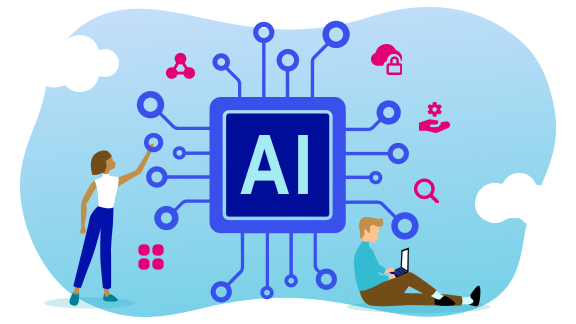
Illustration eines zentralen AI-Symbols, das über Linien mit mehreren Knoten verbunden ist. Zwei Personen sowie Symbole für Sicherheit, Suche und Anwendungen stehen für AI in der Cloud, Cloud-Architektur und digitale Souveränität.

Many discussions about AI focus on GPUs and computing power. In practice, however, an AI application consists of far more than a model. Companies must also develop applications, integrate data, provide user interfaces, implement security policies, and orchestrate business processes, all with a high degree of automation.

A modern AI cloud must therefore support a wide range of requirements:

  • Securely deliver enterprise data.
  • Running applications and APIs.
  • Orchestrate agents and automation.
  • Train and run AI models.
  • Meet compliance and governance requirements.

In theory, all of these functions can run on a single platform. In practice, however, a division of responsibilities often makes more sense. Different workloads benefit from different infrastructure. This principle is familiar from traditional IT architectures, where databases, applications, and storage platforms are deployed separately and optimized for their specific roles.


The two layers of a modern AI platform

Many organizations now deliberately separate platforms for applications and data from specialized infrastructure for GPU-intensive AI workloads. The result is a two-layer architecture built on two complementary platforms.


The platform for applications and data

The first layer runs traditional business applications. This is where data is processed, APIs are exposed, business processes are orchestrated, and user interfaces are hosted. This environment must be flexible, scalable, and cost-effective. It provides the foundation for workflows, agentic AI, enterprise search, intelligent assistants, and data-driven business processes.

In this architecture, a general-purpose cloud can serve as a sovereign AI platform for applications, data, and integration. It can also provide GPU resources, such as NVIDIA H100 GPUs with NVLink, making it well suited for moderate-scale inference and GPU-accelerated application services alongside conventional workloads.


The GPU cloud for compute-intensive AI workloads

The second layer of a modern AI architecture is dedicated to AI processing. It runs compute-intensive workloads such as model training, fine-tuning, high-performance inference, simulations, and GPU-based analytics. These workloads place very different demands on infrastructure than traditional business applications. They require high-performance GPU clusters, high-speed networking, and a platform optimized for distributed AI workloads. These capabilities are typically provided by a specialized GPU cloud.

Modern GPU cloud environments offer access to the latest NVIDIA Blackwell data center accelerators, such as the B200, as well as other GPU classes, including the RTX Pro 6000 series. B200 GPUs are designed for training large language models (LLMs), while the RTX Pro series has a stronger graphics focus and is well suited for Omniverse and digital twin applications. Compared with the previous generation, these GPUs deliver substantially greater tensor processing performance for AI workloads, along with significantly faster interconnects. This makes it possible to train large models and run advanced inference and simulation workloads. Companies gain access to enterprise-grade GPU infrastructure without the capital investment and operational overhead of owning and maintaining the hardware.

For organizations deploying AI at an industrial scale, the GPU cloud becomes the primary computing platform for workloads that demand maximum performance and scalability. Together, the general-purpose cloud and the GPU cloud create a powerful AI platform, with each workload running in the environment where it is technically and economically most effective.


Four typical application scenarios for an AI cloud

1. Agentic AI and intelligent enterprise applications

AI agents require access to applications, data sources, and business processes. While the agent logic, APIs, and integration services run on the general-purpose cloud, the underlying language models can be hosted on a specialized AI cloud for compute-intensive workloads. This creates a powerful AI platform that develops, manages, and seamlessly integrates enterprise applications with AI capabilities.

2. Retrieval-augmented generation (RAG)

Many companies want to make their internal knowledge available to AI applications. In this scenario, documents, databases, and line-of-business applications are connected through the general-purpose cloud. Compute-intensive tasks, such as generating embeddings and processing requests with LLMs, are performed on the more powerful GPU cloud. Vector search, meanwhile, can run on either platform, depending on data volume and performance requirements. The result is an AI platform that securely provides up-to-date enterprise knowledge for AI applications.

3. Fine-tuning your own models

Standard AI models are often insufficient for industry-specific use cases. Fine-tuning allows organizations to adapt existing models using their own data. Data storage and governance remain within the enterprise environment, while GPU-intensive training is offloaded to a specialized GPU cloud.

4. Training and Industrial AI

The two platforms can also work together when training proprietary AI models. The general-purpose cloud provides the foundation for data management, machine learning operations (MLOps), governance, and training data preparation, while the GPU cloud supplies the high-performance GPU resources required for training. This approach follows a proven architectural principle: Each workload runs on the infrastructure best suited to its requirements. Expensive GPU resources are reserved exclusively for compute-intensive AI workloads, while data management, orchestration, and operational tasks remain on a cost-effective general-purpose platform. This improves cost efficiency while simplifying the scaling and operation of AI applications.


Why the combination of both platforms is crucial

The biggest challenge in modern AI environments is often not running individual components, but enabling different platforms to work together. As soon as large volumes of data must be transferred between separate cloud environments, complexity, costs, and security requirements all increase. An integrated AI cloud platform significantly reduces these challenges.

A direct connection between a general-purpose cloud and a GPU cloud enables:

  • Seamless data flow between applications and AI models
  • Consistent security and governance policies
  • Low latency for data-intensive AI workloads
  • Transparent cost structures
  • A unified operating and management environment

Instead of moving data across multiple provider boundaries, applications, data, and AI components remain within a coordinated ecosystem.


General-purpose cloud plus GPU cloud using the example of the T Cloud

Under the T Cloud portfolio, Deutsche Telekom combines a general-purpose cloud with a GPU cloud through T Cloud Public and the Industrial AI Cloud. Together, they provide a flexible AI platform that supports a broad range of AI workloads, from temporary projects to continuous production deployments.

In a typical customer scenario, T Cloud Public handles the preprocessing of large datasets, for example, 1 PB of data stored in object storage. A reduced dataset of approximately 400 TB is then transferred to the Industrial AI Cloud, where it is stored in high-performance storage and used for model training. After processing, the results are returned to T Cloud Public. This architecture assigns each workload to the most appropriate environment, improving both performance and cost efficiency.

High-performance network needed for cloud coupling

A high-performance network connection is essential for linking the two cloud environments. The Industrial AI Cloud provides a site-to-site VPN with bandwidth of up to 2×400 Gbit/s, which is included as part of the service. The VPN uses Deutsche Telekom's IP backbone for transit, making it one of the highest-performance network connections available in Germany. Another option for high-performance integration between the Industrial AI Cloud and other general-purpose cloud environments is the Multi-Cloud Connectivity Platform (MCCP).


Sovereignty as an architectural principle

Alongside performance and scalability, digital sovereignty is becoming increasingly important for European organizations. As AI systems gain access to business-critical data, processes, and decision-making, the need for transparency, control, and regulatory compliance continues to grow. A sovereign AI cloud should provide:

  • Control: Organizations retain full control over data flows, access permissions, and AI processes. Cloud providers have no implicit rights to intervene.
  • Resilience: Operations remain resilient in the face of external disruptions, reducing dependence on individual global cloud providers.
  • Transparency: Data processing and model behavior remain traceable and auditable.
  • Portability: Data and configurations can be migrated between platforms, minimizing vendor lock-in.
  • Compliance: Infrastructure and operating models comply with European regulatory requirements, keep data within European jurisdictions, and support independent auditing.

For organizations in regulated industries, these capabilities are increasingly essential for deploying AI in production.


Conclusion: The next-generation AI cloud

The success of AI depends not only on the quality of the models, but also on the architecture in which those models operate. While general-purpose cloud platforms provide the foundation for applications, data, and integration, AI workloads often require specialized GPU infrastructure. By combining T Cloud Public with the Industrial AI Cloud, organizations can bring these complementary capabilities together in a single AI platform that balances performance, scalability, cost efficiency, and digital sovereignty. The result is a future-ready AI cloud for organizations that want to build applications, leverage enterprise data, and deploy AI at industrial scale, without compromising control, security, or speed of innovation.

 Frequently asked questions (FAQs)

What is the difference between a general-purpose cloud and a GPU cloud?

A general-purpose cloud is designed to support a broad range of applications, data, and integration services in a flexible and cost-effective manner. A GPU cloud is optimized for compute-intensive AI workloads, such as model training, fine-tuning, and high-performance inference, and provides high-performance GPU clusters with fast interconnects.

Do I really need both platforms?

Not necessarily. For smaller, standalone generative AI use cases, a single platform may be sufficient. However, when deploying AI at production scale, especially with model training, fine-tuning, or high inference volumes, separating workloads across two platforms typically delivers both technical and economic benefits.

What happens to latency and cost when moving data between the two platforms?

This is one of the main challenges of hybrid AI architectures. A direct, high-performance connection between the two platforms is essential to minimize latency and maintain predictable costs. Organizations should discuss networking requirements and associated costs with their cloud provider or providers from the outset. For example, they may want to negotiate free outbound data transfers from the general-purpose cloud to the GPU cloud.

Can an AI cloud built on multiple platforms still be sovereign? 

Yes. Sovereignty is determined not by the number of platforms, but by whether data remains within European jurisdictions, operating models comply with European regulatory requirements, and organizations retain control over their data flows. An integrated, unified, and ideally automated architecture can provide these capabilities across multiple platforms.

Which GPUs are used?

The answer depends on the workload. Compute-intensive training and high-performance inference typically use the latest NVIDIA Blackwell data center accelerators, while other workloads may be better served by different GPU classes. The appropriate GPU is selected based on factors such as model size, throughput requirements, and budget.

How can I avoid vendor lock-in?

Vendor lock-in can be minimized by using open interfaces, portable data and model formats, and an architecture that does not depend on proprietary services from a single hyperscale cloud provider. A sovereign cloud strategy should allow workloads to be migrated when business or technical requirements change.

Which organizations benefit most from this approach?

This architecture is particularly valuable for organizations in regulated industries and for enterprises that process business-critical data while deploying AI at industrial scale. It is well suited to environments where high performance, regulatory compliance, and operational control are equally important.


This content might also interest you
 

The BWI Hackathon Trophies

BWI Hackathon harnesses superior GPU power with NVIDIA H100 and L4

At the BWI Data Analytics Hackathon, participants developed AI-based solutions for the German Armed Forces, using the platform provided by T Cloud Public with H100 and L4 GPUs.

 
A circuit board with a processor, and above it the text “s9” on a cloud.

Faster and more cost-efficient – General Purpose with Intel® Xeon® 6900

With the new generation of Intel® Xeon® processors, T Cloud Public is expanding its general-purpose instances and delivering significantly higher performance at no additional cost. Given the ever-increasing demands on computing power, data processing, and user experience, cloud providers face constant competition.

 
An illustration with two people, money, diagrams, and a gauge.

Cloud cost optimization and FinOps

Cloud governance starts pragmatically with cost control: FinOps not only optimizes cloud spending, but also establishes effective governance and control mechanisms.

T Cloud Public Community

This is where users, developers and product owners meet to help each other, share knowledge and discuss.

Discover now

Free expert hotline

Our certified cloud experts provide you with personal service free of charge.

 0800 3304477 (from Germany)

 +800 33044770 (from abroad)

 24 hours a day, seven days a week

Write an E-Mail

Our customer service is available free of charge via E-Mail

Write an E-Mail

AIssistant Cloudia

Our AI-powered search helps with your cloud needs.